
Senior surrendered CPI (Maoist) leader Tippiri Tirupati alias Devji plans to appeal to Union Home Minister Amit Shah to lift the ban on the outfit. He and other surrendered colleagues aim to work legally on people's issues and have also met Telangana DGP C V Anand regarding restrictions on their movements. Tirupati, a former top commander, surrendered in February due to health issues, vowing to work within a legal framework.

Gadchiroli police recovered and destroyed items used in the manufacture of weapons, secretly buried by Maoists in a forest area.

Misir Besra, a banned CPI (Maoist) politburo member with a bounty of over Rs 1 crore and wanted in 141 cases, has been arrested from Jharkhand's Dhanbad district. His arrest is considered a significant achievement in anti-Maoist operations in the state.

A Naxalite was killed and a C-60 commando injured in an ongoing encounter in Gadchiroli district, Maharashtra. The operation, involving multiple C-60 units and CRPF, began after intelligence about the presence of Maoists in the area.

The Supreme Court has agreed to urgently hear the bail plea of advocate Surendra Gadling, who has been incarcerated for seven-and-a-half years in the 2018 Elgar Parishad-Maoist links case, with the hearing scheduled for next week.
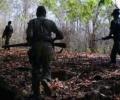
After more than four decades, Chhattisgarh's Bastar region has been declared free of Left-Wing Extremism (LWE), marking the end of the armed Maoist rebellion in the area. The decline is attributed to sustained security operations, improved governance, and socio-economic development initiatives.

The highlight of the occasion, according to officials, is an address to a special gathering in the morning by President Xi Jinping, who cast himself in the mould of Mao Zedong, the founder of the Communist Party of China as it is officially called.

As the March 31 deadline arrives, a wave of Maoist surrenders suggests insurgency's end, but political and social concerns remain.

Top Maoist commander Thippiri Tirupati alias Devji has surrendered to police, marking a significant blow to the outlawed organisation. His surrender comes ahead of the Union government's deadline to eliminate Naxalism.

Forty-one Naxalites, including 32 carrying a reward of Rs 1.19 crore, surrendered in Chhattisgarh's Bijapur district, citing the government's surrender policy and rehabilitation efforts.

'The biggest game changer has been the belief among Maoists that they can surrender and join the mainstream'
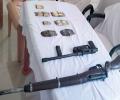
Fifteen Naxalites, including a veteran ultra with a significant bounty, surrendered in Chhattisgarh, effectively dismantling the Maoist movement in the Raipur-Sambalpur region.

A combination of security pressure and rehabilitation efforts has significantly weakened Naxalism in India, leading to numerous surrenders and the elimination of key leaders.

The Supreme Court has directed the Chhattisgarh police to preserve the body of top Maoist commander Katha Ramchandra Reddy, who was killed in an alleged fake encounter. The court has instructed that the body not be buried or cremated until the high court decides on the plea alleging a fake encounter and torture.

A senior Maoist commander, Papa Rao, surrendered with his team in Chhattisgarh, signalling a significant blow to Left-Wing Extremism in the region. This event underscores the impact of sustained security pressure and rehabilitation efforts on the Maoist movement.

Union Home Minister Amit Shah rejects the ceasefire offer from Maoists, stating that surrender is the only option. He also addresses Naxalism's ideological roots and progress in Jammu and Kashmir and the Northeast.

Two CoBRA battalion personnel were seriously injured in an IED blast triggered by Maoists during an anti-Naxal operation in Jharkhand's West Singhbhum district.

Top Maoist leader Ganesh Uike and five other red rebels were killed in gun battles with security forces in Odisha's Kandhamal district.
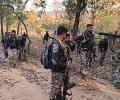
Bodies of three Maoists, including a woman cadre, were recovered from the site, along with a self-loading rifle (SLR), a .303 rifle, a 12-bore gun and other Naxalite-related materials, the SP said.

Seven Maoists were killed in an exchange of fire with police in a forest area in Mulugu district of Telangana on Sunday. The incident occurred during a combing operation in the forest area of Eturnagaram between Greyhounds, an elite anti-naxal force of Telangana Police and the ultras, police said. Among those killed was Kursam Mangu alias Bhadru, Secretary of Telangana State Committee (Yellandu Narsampet) of the banned CPI (Maoist).

The killing of CPI-Maoist general secretary Nambala Keshav Rao alias Basavaraju, the topmost leader by security forces in Chhattisgarh, is a major setback for the banned outfit. Basavaraju, who was on the most wanted list of the NIA, was among the 27 dreaded Naxals killed by security forces in Chhattisgarh's Bastar region. The Telangana Police official said that the killing will be a demoralising factor for the Maoists. The official pointed out that the Maoists are already demoralised and hundreds of their cadres have surrendered before Telangana police besides many being arrested.
Nambala Keshav Rao alias Basavaraju, the powerful general secretary of Communist Party of India-Maoist killed in an encounter along with 26 others on Wednesday, had masterminded several major attacks on security forces in Chhattisgarh and his death is a big blow to the armed movement, said officials.
Three senior leaders of the banned CPI (Maoist) surrendered to the Telangana police. The leaders cited health issues, ideological differences, and changing socio-political circumstances as reasons for their surrender. The Telangana DGP appealed to other underground Maoist cadres to return to the mainstream.
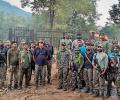
The government informed Lok Sabha that security forces have neutralised 29 top Naxal leaders since 2019, with a significant reduction in affected districts.

'Sujatha's decision to surrender reflects the deep crisis of confidence that the Maoist ranks are facing in recent times.'

Two senior leaders of the banned CPI (Maoist), including a Central Committee Member underground for over four decades, surrendered to Telangana police, citing health issues, pressure from security forces, and ideological differences.
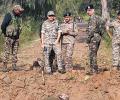
'We are ready to exchange views with the government, primarily through video call.' 'The government should immediately declare a formal ceasefire for a month, stop search operations and take forward the peace process.'

After recent high-intensity operations in the Bastar region and the neutralisation of several senior Maoist leaders, officials say the insurgency has lost its ability to mount large-scale coordinated attacks.

'The watershed moment was June 22, 2024, when the divisional in-charge of Gadchiroli, Giridhar Tumreti, who was their senior-most commander, along with his wife, came forward to surrender before the then deputy chief minister and home minister Devendra Fadnavis.'
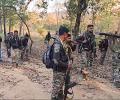
This is the third big success in the past fortnight for security forces pushing relentlessly against the Maoists with the aim of ending the menace by March 2026.

139 Naxalite cadres surrendered in Maharashtra and Chhattisgarh, marking a significant turning point in the fight against Left Wing Extremism. The surrenders included a top Maoist strategist and were hailed as a sign of the movement's decline.


The meeting will focus on the current internal security scenario in the state, with a special emphasis on anti-Maoist operations, the release added.
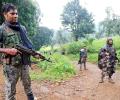
The exchange of fire took place at around 6.45 am in the forest area of Mothe village under Karakagudem police station limits.
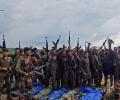
Originally hailing from Andhra Pradesh, the 67-year-old was involved in indoctrination and radicalization of youth and also responsible for numerous Maoist attacks in Chhattisgarh, resulting in the death of civilians and security personnel, they said.

A commander of the banned CPI (Maoist) was killed in a gunfight with security forces in Jharkhand's Palamu district. Another red rebel, carrying a bounty of Rs 15 lakh, was injured in the encounter. Several weapons, including a self-loading rifle, were recovered during the search operation following the gunfight.

Maoists have admitted that 28 cadres, including their top leader Basavaraju, were killed in an encounter with security forces in Chhattisgarh's Bastar region last week. The Naxals also claimed that some of their cadres had surrendered to police and provided information that led to the operation. Police have recovered a large cache of weapons, including an AK-47 looted by Basavaraju from security forces in a 2010 ambush.
'Handling or mitigating a rebellion is not a corporate plan with quarterly, half-yearly and annual goals and results but an aggregation of the effort of several years.'
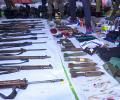
Eight Naxalites were killed in an encounter with security forces in Chhattisgarh's Bijapur district on Saturday. The gunfight broke out in the forest when District Reserve Guard and Special Task Force of the state police along with Central Reserve Police Force (CRPF) and CoBRA (Commando Battalion for Resolute Action) were out on an anti-Naxalite operation. An Insas rifle and a barrel grenade launcher (BGL) were among the weapons recovered from the encounter site. This brings the total number of Naxalites killed in separate encounters in the state this year to 50.
The Communist Party of India (Marxist Leninist), a Naxalite outfit, on Thursday slammed the Maoists for destroying the communist movement by indulging in individual annihilation and facilitating the despatch of para-military forces and commandos to Lalgarh.
